Stroke Intervention
Advanced Brain Stroke Treatment in Mohali, Chandigarh, Punjab |
What Is Stroke Intervention (Mechanical Thrombectomy)?
A stroke happens when a blood clot blocks an artery in the brain, cutting off oxygen and nutrients. Brain cells begin to die within minutes. Doctors call this condition an acute ischemic stroke. It is a life-threatening emergency.
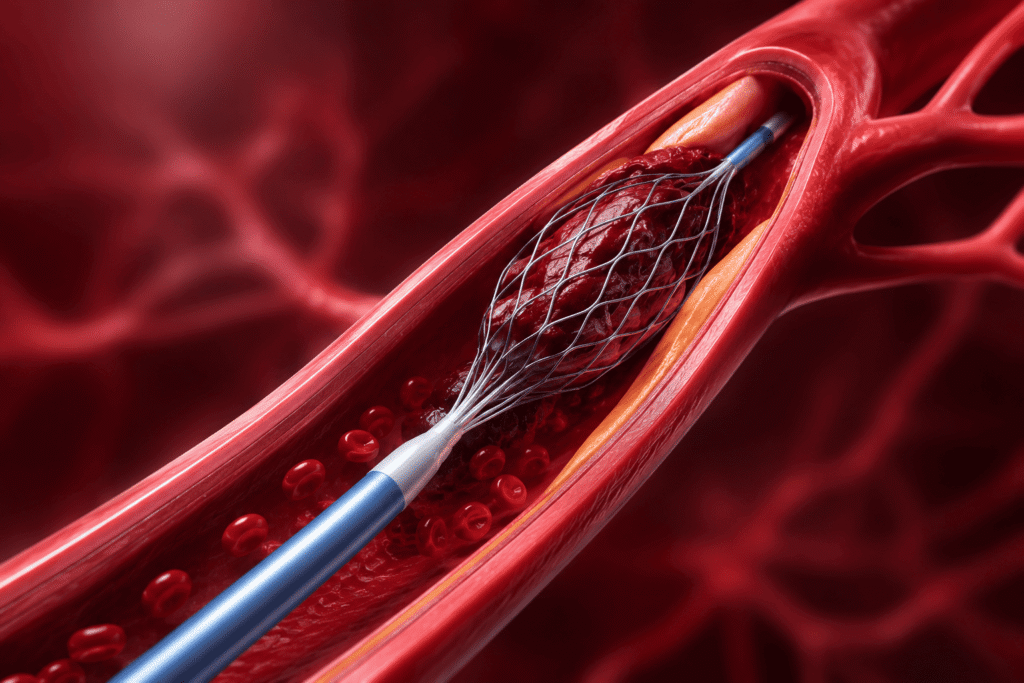
Mechanical thrombectomy is a modern, minimally invasive procedure that physically removes the blood clot from the blocked artery. Think of it like a precision plumbing job for your brain’s blood vessels.
An interventional radiologist, like Dr. Tegbir Sidhu, threads a thin tube (catheter) through an artery in the groin up to the brain. Using a tiny device at the tip of the catheter, the doctor either traps and pulls the clot out or suctions it away. This immediately restores blood flow.
Who Needs This Treatment?
You might need this brain aneurysm treatment in Mohali if you have been diagnosed with an unruptured or a ruptured aneurysm. The decision depends on several factors, including your aneurysm’s size, location, and shape.
✅ The stroke is severe, and a major blood vessel is blocked.
✅ Intravenous clot-busting medication (tPA) does not work effectively or doctors cannot give it.
✅The patient reaches the hospital within the appropriate treatment window.
- A significant advantage is the extended treatment window. While traditional clot-busting drugs have a 4.5-hour window, Doctors can perform mechanical thrombectomy up to 24 hours after symptoms begin in carefully selected patients
Stroke Symptoms You Must Know
- F – Face Drooping: Is one side of the face numb or drooping?
- A – Arm Weakness: Is one arm weak or numb?
- S – Speech Difficulty: Is speech slurred or hard to understand?
- T – Time: Time to call for emergency help.
- Sudden confusion or trouble understanding.
- Sudden trouble seeing in one or both eyes.
- Sudden trouble walking, dizziness, or loss of balance.
- A sudden, severe headache with no known cause.
Causes & Risk Factors

High Blood Pressure (Hypertension)
The single most important modifiable risk factor.

Atrial Fibrillation
An irregular heartbeat that can cause clots to form.

High Cholesterol
Can lead to arterial narrowing.

Diabetes
Damages blood vessels over time.

Smoking & Tobacco Use
Damages blood vessels and increases clotting risk.

Age & Family History
Risk increases with age, and genetics play a role.
Benefits of the Procedure
Choosing mechanical thrombectomy offers significant advantages over other treatments or doing nothing.
High Success Rate:
Restores blood flow in over 80-90% of cases.
Improved Outcomes:
Significantly increases the chance of a good functional recovery and independence.
Minimally Invasive:
This is a brain clot removal procedure done through a tiny puncture in the groin. No large incisions or open brain surgery are required.
Extended Time Window:
Offers a lifeline to patients up to 24 hours after a stroke when other medications aren’t an option.
Rapid Relief:
It works to reverse disability by restoring blood flow immediately.
How the Procedure Works
Step-by-Step:
Access: A small incision is made in the groin to access the femoral artery.
Navigation: A thin catheter is carefully guided through the blood vessels up to the eck and into the brain arteries.
Clot Removal: Once the clot is reached, the doctor uses a special device to remove it.
Stent Retriever: The doctor pushes a tiny mesh stent into the clot, allows it to expand and trap the clot, and then pulls it out.
Aspiration: A catheter uses gentle suction to pull the clot out.
Restoration: “The procedure is complete once blood flow returns to the brain.
Closure: The catheter is withdrawn, and the small puncture site is closed.
Why Choose Dr. Tegbir Sidhu?
✅ Expertise: With over 15 years of experience, he is an expert in endovascular stroke treatment.
✅ Proven Track Record: He has successfully performed mechanical thrombectomy for a wide range of patients, including complex and rare cases, even in children.
✅ Multidisciplinary Team: At Max Hospital Mohali, he works with a dedicated team of neurologists, neurosurgeons, and anesthetists to ensure comprehensive stroke care.
✅ 24×7 Availability: As part of a comprehensive stroke centre in Mohali, the team is ready to treat patients around the clock, understanding that a stroke doesn’t follow business hours.
Treatment Process Step-by-Step
Emergency Arrival
You or your loved one arrives at a stroke-ready hospital.
Rapid Assessment
A neurologist assesses the symptoms, and a CT or MRI scan is done to locate the clot.
Decision
The stroke team decides if mechanical thrombectomy is the best option.
The Procedure
The patient is prepared for the minimally invasive thrombectomy procedure.
Recovery & Monitoring
After the procedure, the patient is shifted to the ICU for close monitoring.
Rehabilitation
Once stable, a comprehensive rehabilitation plan begins.
- Recovery & Aftercare
- Short-Term: The immediate focus is on preventing complications and starting simple movements. The hospital stay is typically a few days.
- Long-Term: The most rapid improvement often happens in the first 3-6 months.
- Rehabilitation: This is crucial and involves:
Physical Therapy: To regain strength, balance, and walking.
Occupational Therapy: To relearn daily tasks like dressing and eating.
Speech Therapy: To help with speaking or swallowing difficulties.
- Risks and Safety
- Bleeding: Bruising or bleeding at the catheter insertion site in the groin.
- Vessel Damage: Injury to the blood vessel from the catheter.
- New Stroke: In very rare cases, a piece of the clot can break off and travel to another artery.
- Bleeding in the Brain: Known as an intracranial hemorrhage, which can be serious.