AVM & DAVF Embolization in Mohali
Minimally Invasive Brain Vascula Treatment |
If you or a loved one has been diagnosed with a brain arteriovenous malformation (AVM) or dural arteriovenous fistula (DAVF), you need expert care you can trust.
Dr. Tegbir Sidhu, a highly experienced interventional radiologist in Mohali, offers advanced, minimally invasive embolization procedures to treat these complex vascular conditions with precision and safety .
What Is Stroke Intervention (Mechanical Thrombectomy)?
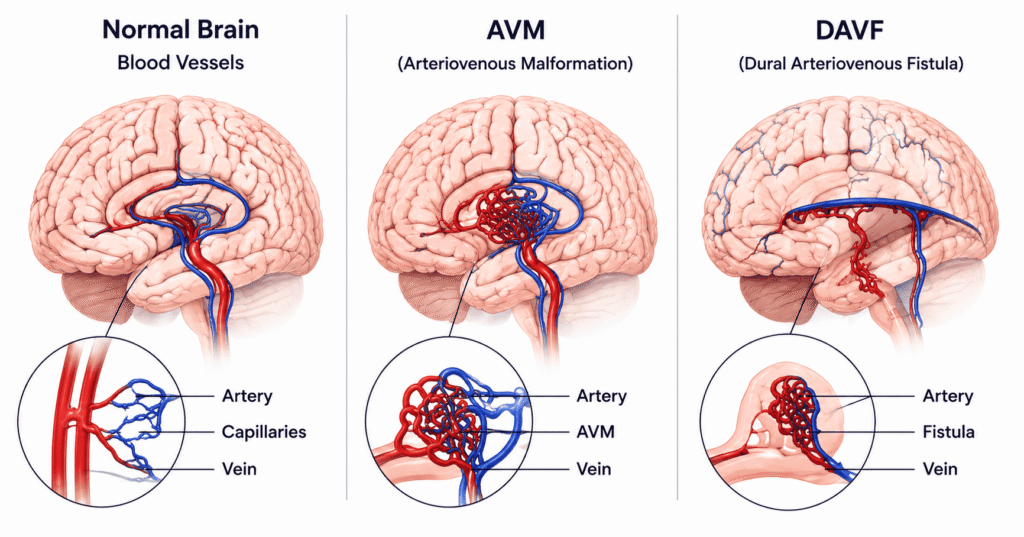
Understanding AVM and DAVF Embolization
What Does Embolization Mean?
Is Embolization Right for You?
- You have been diagnosed with a brain AVM or DAVF that carries a risk of bleeding.
- You experience symptoms such as severe headaches, seizures, or pulsatile tinnitus (a whooshing sound in your ear that matches your heartbeat).
- You are looking for a minimally invasive alternative to open brain surgery.
- Your doctor recommends pre-surgical embolization to reduce blood flow to the AVM, thereby making surgical removal safer.
Recognizing the Signs of a Vascular Malformation
- Suddenly, severe headaches are often described as the “worst headache of your life” .
- Seizures with no prior history.
- Pulsatile tinnitus – hearing a rhythmic whooshing sound in one ear .
- Neurological deficits like weakness, numbness, vision changes, or difficulty speaking.
- Bleeding in the brain (hemorrhage) , which is a medical emergency.
What Causes These Conditions?
- Congenital: Most AVMs are believed to be present from birth, forming during fetal development .
- Acquired: DAVFs can sometimes develop later in life, possibly triggered by:
- Head trauma .
- Previous surgery .
- Venous sinus thrombosis (a blood clot in a brain vein) .
- Hemodynamic Changes: In some cases, as seen in recent medical studies, DAVFs can form after changes in blood flow following AVM treatment . This highlights the importance of choosing an experienced specialist to monitor your long-term recovery.
Why Choose Minimally Invasive Embolization?

Minimally Invasive
No large incisions or craniotomy (opening the skull). The procedure is performed through a small puncture in the groin.

Reduced Risk of Bleeding
Embolization lowers the risk of hemorrhage from the malformation.

Shorter Recovery Time
Compared to open surgery, hospital stays are shorter, and you can return to your daily routine much faster .

Improved Symptoms
Many patients experience immediate relief from symptoms such as pulsatile tinnitus.

Safer Pre-Surgical Step
When used before surgery, it reduces the size and pressure of the AVM, making the operation safer.
- HOW THE PROCEDURE WORKS
When it comes to your brain, you deserve the best. Dr. Tegbir Sidhu is a leading interventional radiologist in Mohali with over 15 years of experience . He is currently practicing at Max Super Speciality Hospital, Mohali, a premier healthcare facility.
- Proven Expertise: He is a member of the Indian Society of Vascular and Interventional Radiology and has handled numerous complex neurovascular cases .
- Patient-Centric Care: Dr. Sidhu is known for his empathy, attention to detail, and commitment to accurate diagnosis.
- Local Access, Global Standards: He brings world-class neurointerventional techniques to patients in Chandigarh, Mohali, Panchkula, Punjab, Haryana, Himachal, Jammu and Kashmir.
- Your Journey to Recovery
- Initial Consultation: A thorough review of your medical history and imaging (MRI, CT Angiogram).
- Pre-Procedure Planning: Dr. Sidhu will design a personalized treatment plan.
- The Embolization Procedure: Performed under general anesthesia in the cath lab. It usually takes 1-3 hours .
- Post-Procedure Observation: You will be monitored in the hospital for 1-2 days.
- Long-Term Follow-Up: Regular imaging (like DSA or MRA) ensures the AVM or DAVF remains closed .
Why Choose Dr. Tegbir Sidhu?
Trust Your Brain to a Mohali Specialist |
When it comes to your brain, you deserve the best. Dr. Tegbir Sidhu is a leading interventional radiologist in Mohali with over 15 years of experience . He is currently practicing at Max Super Speciality Hospital, Mohali, a premier healthcare facility.
✅ Proven Expertise: He is a member of the Indian Society of Vascular and Interventional Radiology and has handled numerous complex neurovascular cases.
✅ Patient-Centric Care: Dr. Sidhu is known for his empathy, attention to detail, and commitment to accurate diagnosis.
✅ Local Access, Global Standards: He brings world-class neurointerventional techniques to patients in Chandigarh, Mohali, Panchkula, Punjab, Haryana, Himachal, Jammu and Kashmir.
Recovery & Aftercare
- Medication to manage pain and prevent complications.
- Guidance on resuming physical activities.
- A schedule for follow-up imaging appointments to monitor your progress.
Risks and Safety
- Bleeding or infection at the catheter insertion site.
- A small risk of stroke or damage to normal blood vessels.
- Recurrence (rare), which is why long-term follow-up is essential .